13 August 2026
Inspected from where?
We thought the pack was nearly finished. Then somebody asked which angle we had been inspecting from, and the pass rate went to eleven out of twenty-seven.
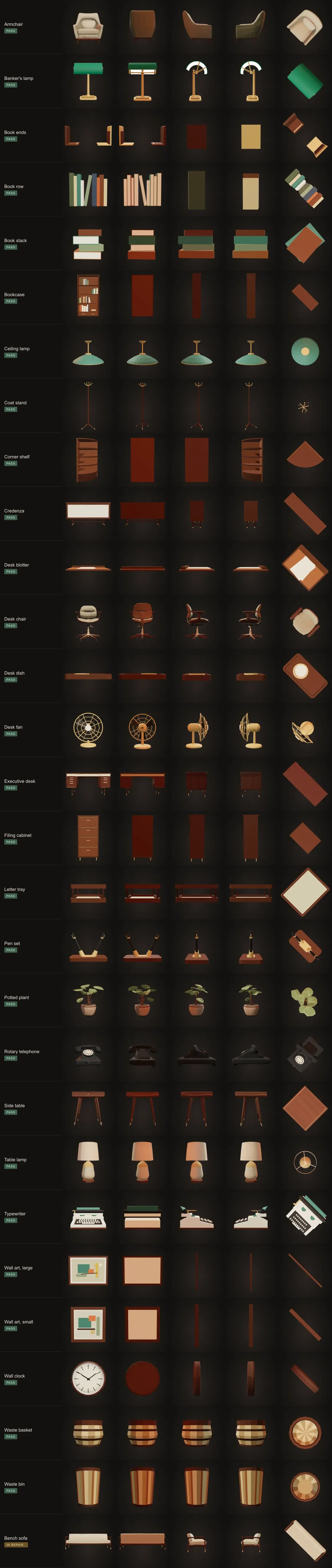
For a couple of weeks we believed the pack was nearly finished.
The renders looked good. The room render looked genuinely good — walnut and sage, tapered legs, brass ferrules catching the window light. Every asset had been inspected and every asset had passed. The remaining work was colour, layout and the storefront listing.
Then somebody asked the obvious question: inspected from where?
One angle is not an inspection
Every asset had been checked from a front three-quarter view. That is the angle you naturally point a camera at an object. It is also the angle a prop is easiest to make look right from, which is exactly why it is the wrong angle to sign off on.
So we built a fixed rig: five cameras — front, back, left, right, top — with the lights bolted down and the object rotating rather than the camera orbiting, so every face gets identical light and no angle is flattered by a convenient shadow. Then we rendered every asset and wrote a verdict for every angle.
The reading came back 11 of 27.
Nothing new had broken. Every one of those defects had existed the whole time, in files we had already called finished, in a set we were about to price. What changed was the angle we were willing to look from.
What was actually wrong
The failures were not random, which is the useful part. Reading the per-angle verdicts, the same four things came up again and again:
Back faces made of crumpled paper. The armchair’s front was convincing. Its back was a field of folds. Not visible from the front three-quarter view. Very visible when a player walks behind it.
Repeating parts fused into one mass. The waste basket came back as a lump with weave painted on it. The book row came back as a single block with spines drawn on the side. Anything with a rhythm had lost the rhythm and kept the texture.
Thin plates gone wavy. The letter tray, the blotter, the picture frames — flat things with real thickness either bloated into pillows or developed rippling edges.
Lettering that fell apart up close. A telephone dial and a typewriter’s keycaps, fine at thumbnail size and unreadable noise at a metre.
What came out of it
Two rules, both of which cost us something immediately, which is how you know they mean anything.
Route by shape. Repeating parts, woven surfaces, thin plates with real thickness and precise joinery are now built parametrically — a slat exists because a loop put it there, shelf spacing is equal because it was computed, nine books on a shelf are nine separate books. Seven pieces the gate had rejected were rebuilt that way and all seven passed.
No readable characters anywhere in the pack. Book spines are colour bands, dials are dots, keycaps are blank. It is what good stylized packs do anyway — no localisation work, no trademark question, and readable 8-point type on a simplified prop is a fidelity mismatch regardless. Enforced in two places rather than one, because a rule that lives only in somebody’s head is not a rule. Four assets went onto the rebuild list the day it was written.
Where it stands
Today the same audit reads 23 pass, 1 in repair, 3 being rebuilt. A repair round took the wall clock, the desk, the side table and the table lamp from yellow to green by fixing the located defect rather than rebuilding the asset. The bench sofa is the one still in repair.
The live figure is on the standard page and per-asset on the pack page, both read out of the audit file at build time rather than from a sentence somebody typed. This paragraph is a snapshot; those are the source.
The pack ships when every prop in it clears the gate. Not before.
The thing worth taking from this
A check is only worth what its worst case catches, and the natural inspection angle is always the one the work is best at.
If you build assets, the cheapest quality improvement available to you is a fixed rig that shows you the side you were not going to look at. It costs an afternoon to build. It found eight weeks of work we did not know we had.
audit quality process
More
- A globe is a trap We cut a globe from the pack and replaced it with book ends. The rule that came out of it now filters every asset list before a single piece gets designed.
- Why we build props with code Most of this pack is a few hundred lines of Blender Python per asset. Not a position on craft — it was the cheapest way to make a fix cost nothing.